Monday, April 7, 2014

What Is Progressivism?


AM (an American combat aviator with an inquiring mind):  Gadfly, we are now starting to hear the term progressive mentioned more and more in the public narrative.  It sounds, well, “progressive,” implying deliberate efforts toward “progress.”

Old Gadfly:  Yes, the term is very seductive.

IM (an American citizen with an inquiring mind):  I have even heard some of my relatively “conservative” friends claim to be progressive, typically as in a Teddy Roosevelt progressive.  As I understand it, Teddy was one of the first American advocates of progressivism, a political movement historians refer to as the Progressive Era, 1890s-1920s.


AM:  This progressive era focused on (a) cleaning up corruption in government (i.e., political machines) through direct democracy: and (b) reigning in monopolies through antitrust laws and actions, mostly for the benefit of fair competition and for the benefit of consumers.  Proponents of these objectives consisted of Republicans (e.g., Teddy Roosevelt and Wisconsin’s Robert La Follette) and Democrats (e.g., William Jennings Bryan and Woodrow Wilson).     

Old Gadfly:  The focus seemed appropriate, whether Republican or Democrat.  So, it seems to me that the progressive era was a good thing for America.  Am I wrong?

IM:  Good question.

Old Gadfly:  What was going on in America at the time?

AM:  America was still transforming based on technology-driven industrialization. America shifted from an agricultural, rural nation to and industrialized, urban nation that lacked institutions to accommodate these changes.

Old Gadfly:  What do you mean by “institutions”?

AM:  I found one of the books in your study particularly useful for answering that question.  Douglass North, in his book, Institutions, Institutional Change and Economic Performance, defined an institution as simply, “the rules of the game.”[1]  North expands on this simple definition by explaining that institutions are “the humanly devised constraints that shape human interaction.  In consequence, they structure incentives in human exchange, whether political, social, or economic.  Institutional change shapes the way societies evolve through time and hence is the key to understanding historical change.”[2]  Thus, in answer to your bigger question, Teddy Roosevelt advocated new rules of the game to better accommodate the technology-driven changes taking place in America.

Old Gadfly:   All this sounds like a good and needed approach.  Yet, why was the term progressive used as opposed to modernism, solutionism, or some equivalent word?

IM:  Do you think it related to the idea of progress?

Old Gadfly:  What do you think?  Is there such an idea?

IM:  Yes, it stemmed from the Age of Enlightenment.

Old Gadfly:  Explain.

IM:  The theory of the idea of progress subscribes to a combination of technology, science, and social action (e.g., social engineering) to improve the human condition.

AM:  We have seen where single elements or combinations have produced positive and negative results.  For example, nuclear energy can be used for electrical power for the benefit of many people or it can be used for death and destruction.  So, these concepts can improve or adversely impact the human condition.

Old Gadfly:  Excellent point, AM.  So, if the idea of progress can have different paths, that is, creative versus destructive, then what is the determinant of those paths?

AM:  Any application of technology, science, or social action is based on human decision-making.

Old Gadfly:  I agree.  Now, how does this decision-making relate to the nature of progressivism?

IM:  It requires someone or a like-minded group to make decisions.

Old Gadfly:  And this is why progressivism is seductive and dangerous.  The notion of progressivism emerged based on reasonable expectations to accommodate major changes taking place in the American culture with new institutions; yet, the scope and application of progressivism evolved over time.  As a consequence, many today who favor progress believe they are a “progressive.” 

IM:  So, those who understand the seductiveness and danger of progressivism are considered “conservative” and opposed to progress.  That is why it is so customary today to hear the left accuse the right of being anti-women, anti-black, anti-gay, anti-equality (this runs the gamut from income inequality, gender-based wage inequality, to marriage inequality), anti-immigrant, anti-reproductive rights, and so forth.    

AM:  It appears that the major leftward evolution of progressivism took place during Woodrow Wilson’s presidency. 

Old Gadfly:  What was Wilson’s view?


AM:  The main tenet of Wilson’s progressivism is that central planners with superior knowledge could advance policy to promote the idea of progress for the benefit of the people.  Wilson was critical of a constitutional republic because it was based on property ownership and individual rights.  He believed that the principles of democracy and socialism were essentially the same, with socialism being a more advanced condition that only the historical evolution of organizational institutions (i.e., a large, national, central government) could support.  Ronald Pestritto provides evidence of this view based on a critical analysis of Wilson’s documented writings and actions in his book, Woodrow Wilson and the Roots of Modern Liberalism.[3] 

IM:  Pestritto also provided an excellent analysis, often ignored in histories and biographies, of Wilson’s view on the role of “progressive races” in the historical development of the modern state.[4]  He was openly critical of post-Civil War Reconstruction because “blacks were an inferior race.”[5]  Thomas Sowell, in his book, Intellectuals and Race, provided a wealth of evidence about Wilson’s and the American political elite’s fascination with and advocacy of eugenics.[6]  Margaret Sanger’s Planned Parenthood is a modern legacy of this thinking.[7]

Old Gadfly:  A little more than a year ago, I visited the presidential library of Franklin Delano Roosevelt.  In one of the displays, I was amazed to read the explicit acknowledgement by FDR of his admiration for Wilson’s progressive views.  So, as I turned the corner and examined a series of panels listing all the New Deal policy changes FDR instituted during the course of his presidency, I began to realize how serious this group of American progressive political elite was in transforming America from a constitutional republic to a socialistic democracy.


IM:  It was also during this timeframe that American political elite traveled to Europe and Russia to see first had the great experiments by Hitler and Stalin to advance the human condition.  As Amity Shlaes described it in her book, The Forgotten Man, collective freedom observed by these elite seemed superior to individual freedom.[8]

AM:  The American political elite’s admiration of the statist and social engineering efforts taking place under Hitler and Stalin gave birth to the neoconservative movement.  Francis Fukuyama explained this development it in his book, America at the Crossroads:  Democracy, Power, and the Neoconservative Legacy.[9]  He traced the roots of neoconservatism to City College of New York in the mid-1930s to early 1940s, where a group of Jewish intellectuals attended as students.  A late-comer to this group was Daniel Patrick Moynihan.  There were two major reasons for splitting away from their left-wing liberal colleagues.  The first reason was their disgust for communism and those who sympathized with communist developments in the 30s and 40s.  These founding neoconservatives generally had no issue with the idealism of socialism; yet they saw the realities of socialism—its evil manifestations stemming from the Hitler-Stalin pact and other significant unintended consequences—and wanted nothing of it.  The second major reason for the split from their liberal colleagues was the liberal’s passion for social engineering.  Social engineering, as an egalitarian approach to shaping society, assumed perfect knowledge by elite who conceived the engineering.  These elite were members of a central planning effort within the government.  The evolving progressive ideology had already demonstrated its similarities to the statist and socialist movements in Germany and the Soviet Union.

Old Gadfly:  When you say, egalitarian approach.  What do you mean by that?

AM:  Egalitarianism is a manifestation of modern liberalism and progressivism.  Its guiding principle is equality of outcomes.  Thus, egalitarianism chooses equality of outcomes over freedom of choice.  According to Milton Friedman, a classical liberal is encouraged by greater material equality in a free society, trusting that material equality is a by-product of a free society.  Progressives are not content with this dynamic; they feel morally obligated to take control of society and justify taking from some to give to others as the “just” thing to do.[10]  Even the celebrated John Rawls, a Harvard political philosopher, argued for egalitarian approaches in his book, A Theory of Justice.  Rawls claimed an impartial system of justice is not possible, even in modern, civil societies because of various conceptions of justice.  Thus, he argued, “Clearly this distinction between the concept [ideal, impartial justice] and the various conceptions of justice settles no important questions.  It simply helps to identify the role of the principles of social justice”.[11]   Consequently, in Rawls’ reasoned judgment, justice in the form of “social justice” is a means, not an end.  Egalitarian approaches, as a form of social justice, are morally coercive because they “take away” and “give to” in the spirit of equal outcomes.  Progressives believe central planners of superior intellect can make these types of decisions.  Forced redistribution of wealth is a classic example.

IM:  C.S. Lewis addressed this coerciveness in his book, The Abolition of Man.[12]  His chapter, “Men without Chests,” challenges political correctness and the threat to free and spontaneous expression and behaviors.  Lewis wrote in the mid-1940s.  During this same period, “progressive” developments in the Soviet Union prompted Winston Churchill to give his “Iron Curtain” speech (the real title was The Sinews of Peace, delivered on March 5, 1946 at Westminster College in Fulton Missouri—after losing reelection).  Stalin denounced Churchill’s speech and accused him of “racism.”


AM:  Stalin’s reaction is interesting and ironic.  In modern America, it is typical for a progressive to accuse those on the right as being racist (as well as homophobes, xenophobes, anti-women, etc.).

IM:  Incidentally, F. A. Hayek, like C. S. Lewis, explained how progressive central planners even insist people internalizing values that the planners determine.  In Chapter 11, “The End of Truth,” in The Road to Serfdom, Hayek explained:

The most effective way of making everybody serve the single system of ends toward which the social plan is directed is to make everybody believe in those ends. . . . It is essential that the people should come to regard them as their own ends.  Although the beliefs must be chosen for the people and imposed upon them, they must become their beliefs, a generally accepted creed which makes the individuals as far as possible act spontaneously in the way the planner wants.[13]

AM:  Lewis and Hayek wrote in the 1940s.  Their observations certainly apply to the emotional reaction and labeling by those on the left in America today.  Secretary of State Kerry recently called global warming skeptics members of the Flat Earth Society.  Yet, while the Intergovernmental Panel on Climate Change (IPCC) politicizes a consensus view among 52 scientists, there are over 700 who disagree for a variety of legitimate, scientific reasons.  

Old Gadfly:  What you are describing AM is how progressives use scientism, not science, to advance their notion of progress.  In another conversation, we’ll discuss scientism in greater depth. Meanwhile, we have discussed the Progressive Era and some of its spinoff manifestations from Wilson and FDR.  Is there any other evidence of progressivism in America since FDR?

IM:  As I understand the evolution of the neoconservative movement, there was a “second wave” stemming from the emergence of the “New Left” led by Tom Hayden who authored the Port Huron Statement in 1962 that spawned the Students for a Democratic Society.  As Fukuyama asserted, the New Left fueled a “revival of large-scale social engineering on the part of the U.S. Government, in the form of Lyndon Johnson’s War on Poverty and Great Society Programs.”[14] 


AM:  In 1966, Richard Cloward and Frances Fox Piven published an article that laid out a political strategy to overload the welfare system to precipitate a crisis that would justify (a) blaming capitalism for its inherent flaws, and (b) replacing our economic system with socialism and a government run guarantee of equal income for everyone.[15]  Given this New Left momentum, combined with significant Democrat majorities in both houses of Congress (see table below), Lyndon Johnson resurrected progressivism after significant stability and infrastructure investments under the Eisenhower Administration. 


IM:  Barack Obama has taken progressivism even further leftward with his hope and change agenda.  The further left it moves, the more coercive it becomes.  Obamacare is an obvious example.


Old Gadfly: Excellent analysis, gentlemen.  So, we have arrived at a definition of modern progressivism:  a belief that central planners with superior knowledge can combine technology, science, and social action in such a way as to improve the human condition, using coercion if needed.  This approach seems to completely disregard the importance of individual liberty.  We have also mentioned other concepts such as Democrat, Republican, modern liberalism, classical liberalism, and so forth.  In our next conversation, let us further define various terms and then place them on a political map to see if we can further understand where we are today in America.  


[1] Douglass C.  North, Institutions, Institutional Change and Economic Performance.  (Cambridge, UK:  Cambridge University Press, 1990).
[2] Ibid, p. 3.
[3] Ronald J. Pestritto, Woodrow Wilson and the Roots of Modern Liberalism.  (New York, NY:  Rowman and Littlefield Publishers, Inc., 2005).
[4] Ibid, pp. 43-45.
[5] Ibid, p. 44.
[6] Thomas Sowell, Intellectuals and Race.  (New York, NY: Basic Books, 2013)
[7] Vanessa Murphree and Karla K. Gower, “’Making Birth Control Respectable’:  The Birth Control Review, 1917-1928.”  American Journalism, Volume 30, Issue 2 (2013), pp. 210-234.
[8] Amity Shlaes, The Forgotten Man:  A New History of the Great Depression.  (New York, NY:  Harper, 2007), pp. 78-139.
[9] Francis Fukuyama, America at the Crossroads:  Democracy, Power, and the Neoconservative Legacy.  (New Haven, CT:  Yale University Press, 2006), pp. 14-21.
[10] Milton Friedman, Capitalism and Freedom, 40th Anniversary Edition, (Chicago:  University of Chicago Press, 2002), p. 195.
[11] John Rawls, A Theory of Justice, Revised Edition.  (Cambridge, MA:  Belknap Press of Harvard University Press, 2003 (originally published in 1971]), p. 5.
[12] C. S. Lewis, The Abolition of Man.  (New York, NY:  Simon & Schuster, 1996 [originally published in 1944]).
[13] F. A. Hayek, The Road to Serfdom, The Definitive Edition, Edited by Bruce Caldwell.  (Chicago, IL:  The University of Chicago Press, 2007 [originally published in 1944]), p. 171.
[14] Fukuyama, op cit., p. 18.
[15] Richard Cloward and Frances Piven, “The Weight of the Poor:  A Strategy to End Poverty.” The Nation (May 2, 1966).  Available at http://www.commondreams.org/headline/2010/03/24-4.  If you visit the website, note the subtitle under Common Dreams:  “Building a Progressive Community.”

Wednesday, April 2, 2014

Honor versus Dishonor


IM (an American citizen with an inquiring mind):  Gadfly, I have done my homework on progressivism and believe I am ready to contribute to our conversation.  Meanwhile, AM, are you aware of the cheating scandal by missile officers at Malmstrom Air Force Base in Montana?

AM:  (an American combat aviator with an inquiring mind):  Yes, I am.  There was a national outcry because these officers have nuclear ICBM responsibilities.

Old Gadfly:  Yes.  And, it was especially noted that some of the officers were Air Force Academy graduates, who were taught the importance of an honor code.

IM:  Perhaps the Academy failed to instill an enduring sense of honor.

Old Gadfly:  A very wise idiom claims “one swallow does not make a summer.”  The wisdom cautions against the tendency to generalize.  Yet, generalizations are made or implied (also, here and here) about honor violations associated with the Service Academies, which diminishes the value of such institutions that exist within the broader culture of society.  Keep in mind; cadets arrive at the Academy from society at large.  The Josephson Institute recently indicated that while there seems to be some improvement over the past 2 years, the percentage of American high school seniors who admit to lying, cheating, or stealing is 55%, 51%, and 20%, respectively.  The recent Academy chemistry cheating scandal included 40 first-year cadets.  Among the more than 1,000 first-year cadets, that represents 4%.  Among the entire cadet wing, this number represents 1%.  I say all this not to exonerate dishonorable behavior, but to put it into context.

AM:  Just this morning, I read a letter from the wing commander at Malmstrom to members of his command.  Several lines in Colonel Stanley’s letter caught my attention:  We've seen the reputation of our beloved wing and America's ICBM mission tarnished because of the extraordinarily selfish actions of officers entrusted with the most powerful weapon system ever devised by man.”  Here Stanley acknowledges the seriousness of this breach of honor. 


AM:  Stanley then goes on to say:

Our amazing airmen and their families, the astoundingly supportive community and the successes of Wing One have far outweighed the bad. Just being allowed to be a small part of your lives is a memory that Cheryl and I will cherish forever. But, like all things of great value, such blessings come with equally great costs. I represent this wing to the world, and we let the American people down on my watch. 

With that realization, and the genuine hope that my action will stir even the most apathetic hearts to action, I have decided to volunteer my resignation from this post effective immediately. This request has been accepted. I have also requested, and been approved for, retirement from the United States Air Force. If this sacrifice by Cheryl and me influences just one airman to stand up for what's right the next time they are confronted by immorality, it will have been worth every tear and sleepless night.

IM:  So, not only did Colonel Stanley assume responsibility for what happened under his command, he held himself accountable by resigning and retiring from the Air Force.  By doing so, he is demonstrating character-based leadership to inspire others to act when needed.

AM:  Yes.  Think about it.  Colonel Stanley did not cheat.  But, it happened under his leadership.

Old Gadfly:   Stanley was the proverbial captain of the ship.  IM, do you remember our conversation about the empty chair?  You mentioned a Wall Street Journal editorial published on May 14, 1952.  A collision between the USS Wasp and USS Hornet on April 26, 1952 resulted in the loss of 176 crewmembers.  You said, “The editorial claimed that with responsibility comes accountability.  Without accountability, there is no responsibility.”  You then reminded me that our President is the captain of our ship of state, and quoted a passage from the editorial:

It is cruel, this accountability of good and well-intentioned men.  But, the choice is that, or an end to responsibility and, finally, as the cruel sea has taught, an end to the confidence and trust in the men who lead, for men will not long trust leaders who feel themselves beyond accountability for what they do.

AM:  Colonel Stanley also passed on an important lesson:  “Had just one solitary airman spoken up for integrity, our leadership team would have been able to take action immediately.

Old Gadfly:  Do you think this lesson applies to just those who serve in our armed forces?

AM:  Of course not.  The former Secretary of State “took responsibility” for the tragedy at Benghazi; but, where was the accountability?  Perhaps her advice to the Secretary of Defense and general officers regarding the Malmstrom incident might be, “what difference does it make”?


IM:  IRS’s Lois Lerner was directly involved in violating the Constitutional right to speech for many conservative groups between the 2010 and 2012 elections, yet invoked the Fifth Amendment when she had an opportunity to achieve accountability. 


IM:  And then, the same commander-in-chief, who said there were merely stupid mistakes made by rogue members of the IRS and claimed Obamacare would let people keep their doctors and plans, offhandedly referred to the Benghazi attack (and by implication the four American deaths) and other Middle East unrest as “speed bumps.”


AM:  The editorial talked about accountability of well-intentioned men.  I see this happening at Malmstrom.  Elsewhere, I see a lack of accountability of not so well-intentioned people, who seem to be getting away with their ideological agenda of fundamentally transforming America, despite occasional speed bumps. Will America turn out to be that “cruel sea” that will demand “an end to the confidence and trust in the men who lead,” because “men will not long trust leaders who feel themselves beyond accountability for what they do”?

Old Gadfly:  One can only hope.  Meanwhile, it remains important for us to support and encourage character development for future leaders at the Academies.   

Sunday, March 30, 2014

Yes, We Can!


Ring . . . Ring . . .

Old Gadfly:  Hello?

AM (an American combat aviator with an inquiring mind):  Gadfly, I understand Putin’s motivation.

Old Gadfly:  How so, AM?

AM:  Putin is plagiarizing his nemesis, the one who referred to Putin as a playground bully and regional power.

Old Gadfly:  Stating the obvious, you mean President Obama?


AM:  Absolutely.

Old Gadfly:  Explain.

AM:  Remember when the Obama campaign used the slogan, “Yes, we can”?

Old Gadfly:  Yes, I remember.  Your point?

AM:  Much has happened during the Obama Administration:  Solyndra; Fast and Furious; Benghazi; Justice Department attacks on journalists, J.P. Morgan, and private citizens (Arpaio, Dinesh D’Souza, etc.); IRS censoring ;political opposition; Obamacare (winners and losers in redistributing wealth) along with the 38 Executive Branch violations of the law; and so forth.  So far, there has been absolutely no accountability.

Old Gadfly:  Ergo, “Yes, we can.”  Obama moves forward with his progressive ideology because he is getting away with it.  And now Obama gets to work with someone who has similar motivations about centralizing power, but with a far greater approval rating from his subjects, who would gladly exchange liberty for security.

AM:  Unfortunately, a lot of people get to suffer the results of the grab for power in both "regions."  Yes, I refer to the United States as a regional power because it has squandered its international power status during this current Administration.

Old Gadfly:  During our next conversation, let’s talk about progressivism to see if we can sufficiently define it and locate it on a political map.

AM:  I look forward to it.


Monday, December 16, 2013

Tea Party in Wonderland


AM (an American combat aviator with an inquiring mind):  Gentlemen, today is the 240th anniversary of the Boston Tea Party (December 16, 1773).  These brave Americans sparked the movement that led to our independence as a nation.  And we know what they stood for because the ideals were boldly advanced in our Declaration of Independence.  Yet, Americans today, who claim to be affiliated with the Tea Party movement, are treated as far right wing extremists.  Unlike our ancestors, these Americans are not seeking a revolution; they simply want to restore the ideals that made America the envy of the world.

Old Gadfly:  Since we seem to have a fairly realistic understanding of our history and the political philosophy embraced by the Framers of our Constitution, today’s Tea Party appears to be experiencing the same kind of surrealism as Lewis Carroll’s Alice’s Adventures in Wonderland.

IM (an American citizen with an inquiring mind):  You suggest an interesting analogy, Gadfly.  What rabbit hole did they find?


AM:  The upside down world of politics.

Old Gadfly:  Explain.

AM:  Bluntly, while labeled far right and extremist, the Tea Party may be the only true voice of reason and authentic liberalism these days.  As I find myself spending more and more time in Gadfly’s library, I’m starting to see things differently.  Yesterday, I read F. A. Hayek’s postscript, “Why I Am Not a Conservative,” in his book, The Constitution of Liberty.  Hayek considered himself to be a liberal, but not in the way the term has been coopted by today’s “modern liberals” or progressives.  To Hayek, an authentic liberal was an advocate for individual liberty, a champion for removing obstacles to free growth (and conversely opposing new obstacles to free growth), and a defender of the long-standing institutions that enabled both liberty and growth.[1]  Modern liberals, on the other hand, and progressives are socialistic, not liberal, and they actually manifest the concept called conservatism.  Hayek compared liberalism and conservatism in the following way: 

Unlike liberalism, with its fundamental belief in the long-range power of ideas, conservatism is bound by the stock of ideas inherited at a given time.  And since it does not really believe in the power of argument, its last resort is generally a claim to superior wisdom, based on some self-arrogated superior quality.[2]

 Old Gadfly:  It is not easy to follow Hayek because he is trying to instantiate a moving target regarding liberal and conservative dispositions of political philosophy in America’s political wonderland.  Many Republicans find themselves aligning more and more with socialistic policies of Democrats to curry favor for a label of “moderate” and fear being called “right wing.”  Some Republicans have opposed new obstacles to free growth (i.e., Obamacare, unbridled government debt, unbridled regulations, and any scheme for wealth redistribution).  As we have seen, they are called extremists, even by fellow Republicans who would rather go along to get along.  I still find it unfathomable that some Republicans still blame other Republicans for the recent government shutdown.  In essence, these acquiescing Republicans demonstrated exactly what Hayek was observing and writing about in The Constitution of Liberty.  Instead of standing for a set of principles, Republicans react to prevailing political momentum.  And, while it is the “modern liberal,” progressive Democrat faction that commands the direction of the prevailing political philosophy in America, which is increasingly socialistic, Republicans have failed to articulate an alternate philosophy to change public sentiment.  Thus, our nation drifts further and more rapidly toward a socialistic welfare state.

IM:  Wait a minute, Gadfly.  Democrats are generally recognized as liberals, and the party of ideas and social justice.  Republicans are generally considered conservative, the party of opposition, the party with no ideas.

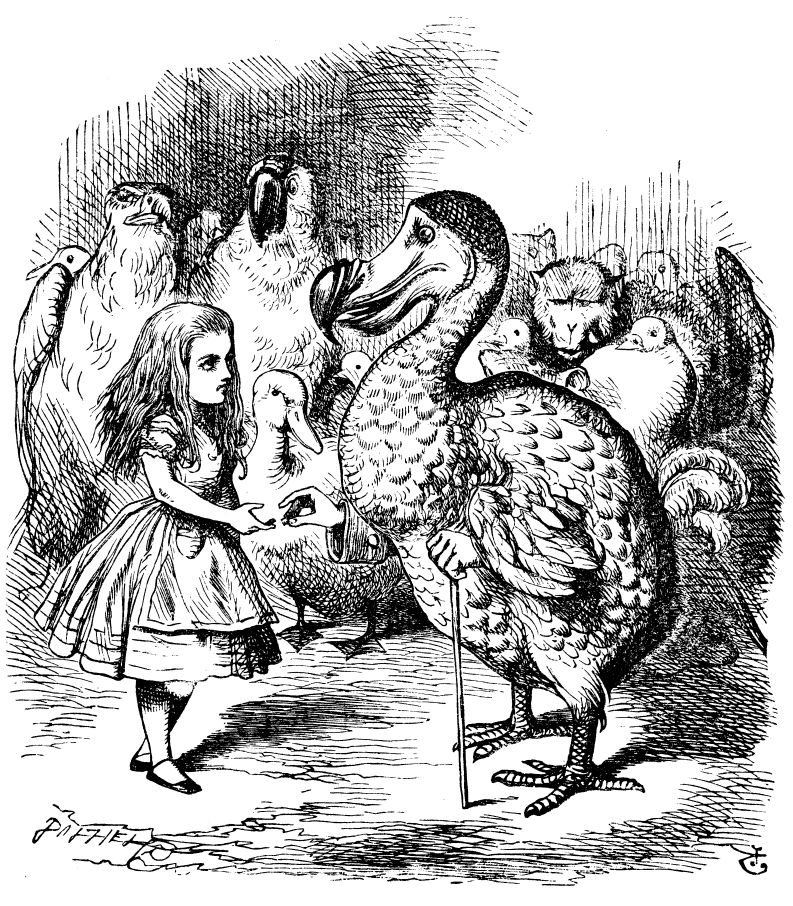
Old Gadfly:  Yes, but that view is more myth than reality.  Our target audience for this analysis is the American people, not politicians.  It is the American people that advance ideas for innovation and progress.  The only ideas politicians have, whether Democrat or Republican, are how best to promise a good society to get elected.  The Democrat’s idea of social justice is justification for redistributing wealth.  These myths are why I say politics in modern America is like Alice’s Adventures in Wonderland.   Unfortunately, the Democrat Party was inflicted with its progressive view in the 1930s.  Ironically, today’s Democrat Party actually demonstrates Hayek’s notion of conservatism because Democrat politicians are bound by the stock of ideas they inherited from Woodrow Wilson and institutionalized to a certain extent by Franklin Roosevelt and Lyndon Johnson.  The craziness of progressive politicians reminds me of the scene with Dodo, where he proposes a caucus race where everyone runs in some pattern of his or her own choosing, ending up where each began and each receiving a prize for “winning the race.”  The scene was pure satire on the ambiguity and indecisiveness of a political system; and, in this case, it figuratively describes the progressive political system. 


IM:  How does Hayek explain progressivism? 

AM:   Progressivism is a belief that political elite have superior knowledge and can advance progress through policies that will benefit the masses.  This is why they believe in strong, central government for planning and execution.  The ideology is socialistic in nature and has led to an explosion in entitlement programs.  Thus, governing principles are based on the two big Rs for political action:  redistribute wealth and regulate affairs in political, social, and economic domains.

Old Gadfly:  AM, let me interrupt you for a minute.  I recently read testimony by Dr. Roger Pilon, a Constitutional scholar, before a U.S. Senate Committee on October 25, 2005.  What I found striking about the testimony is that the majority of the laws and policies enacted in 1937 and 1938 exceeded the authority granted by the Constitution.  In the years 1937 and 1938 the Senate consisted of 76 Democrats to 16 Republicans, while the House consisted of 334 Democrats and only 88 Republicans.  Prior to his reelection in 1936, there was much debate within the Roosevelt Administration regarding how to deal with the US Supreme Court’s “nine old men” who were resistant to unconstitutional laws and regulations.  Roosevelt publicly threatened to pack the court with six more associate justices who would be comfortable with progressive intentions.  While this did not happen, the Court conspicuously changed its strict Constitutional lens and began rewriting the Constitution through Court rulings, not Amendments.  Does this sound familiar?  Remember when President Obama publicly rebuked the Supreme Court for its Citizen’s United-ruling during a State of the Union Address?  Perhaps Chief Justice Roberts had the Roosevelt experience in mind when he ruled the individual mandate was a tax in the Affordable Healthcare Act ruling—a ruling considered by many Constitutional scholars to be contrary to the enumerated powers of the Constitution.  Add to this Senator Reid’s historic and unprecedented rule change in the Senate (i.e., the nuclear option that allows a simple majority vote when a super majority vote was normally required) to break the logjam on Presidential nominees to key Administrative positions and federal courts, and we can see unbridled progressive power in full play.  Why is this alarming?  Three progressive nominees to a key Washington D.C. court will shift the current balance (now three liberal and three conservatives) in such a manner (six to three rulings) as to protect bold and sweeping rules and regulations being implemented by the Obama Administration.  These rules and regulations far exceed the enumerated powers delegated by the people in the U.S. Constitution.

IM:  Are there any regulations that we should worry about?

Old Gadfly:  Yes, the EPA is about to further impede economic free growth with new rules.  But the one that troubles me the most is the Treasury Department’s effort to prohibit 501(c)4 organizations from financially contributing to political campaigns.  This is the new tactic being employed to shut down many of the Tea Party and equivalent organizations that were successfully censored (and harassed) by the Internal Revenue Service between 2010 and 2012 (a tactic that was very successful until Congress became aware of it and started inquiring about it).  With a stacked progressive Court, these new rules will be protected.  Conspicuously absent is no Treasury Department effort to prohibit 501(c)5 organizations from supporting political campaigns.  This is the tax-exempt code for labor organizations.  The 501(c)4 distinction is available for left- or right-wing groups.  But, even in this current American political Wonderland, 501(c)5 organizations are all left-wing.  And, amazingly, following the government shutdown, more federal employees joined unions, even though they are public servants who serve at the pleasure of the American taxpayer.  Even the Hatter in Alice’s Adventures in Wonderland would find this riddle to be a riddle wrapped inside a riddle.

AM:  How do we get out of this rabbit hole?
           Old Gadfly:  Following Hayek’s logic, the closest term to authentic liberalism in today’s vernacular is “libertarian.”  Libertarians believe in liberty, free growth, and the time-tested traditional institutions, such as a constitution with enumerated powers to limit the powers of government.  Members of existing political parties, whether Democrat or Republican, should try to better understand what the authentic liberal, now libertarian-oriented Tea Party movement represents.  This understanding is needed if they want our nation to regain its authentic American liberal ideals and the progress and prosperity they once generated.


[1] F. A. Hayek, The Constitution of Liberty (The Definitive Edition), (Chicago, IL:  The University of Chicago Press, 2011 [1960]),  pp. 520-521.
[2] Ibid, p. 526.